Hot Air and High Prices
Why Somms Are Looking Beyond Napa Valley Cabs
I’m not one to disparage the old names that cemented American viticulture on the world stage in 1976. Before the eyes of some of the finest minds in viticulture, Château Montalena and Stags Leap Vineyards distinguished themselves when drunk besides names that had existed for centuries. For over 120 years, the 1855 Classification of Bordeaux had ruled what made one wine twice as expensive as another. The same thing has been happening for the past 50 years, since the French admitted we Americans can make a pretty good bottle of wine.
In 1855, Napoléon III, Emperor of France, declared that the wines of Bordeaux would be classified. Now— let’s be clear, even as late as 1855, there were few international organizations that could determine the objective quality of wine, even wine as well-known as those from Bordeaux. Napoléon III’s experts were flying by the seat of their pants when they classified their top five crus or “growths” of Bordeaux. In the end, they used the most objective number they had: price.
The top five most expensive châteaux in Bordeaux became the five Premier Cru Châteaux, or First Growth Producers. Beneath those top five, there is a complex web of bankruptcies, acquisitions, marriages, and double-barrel renamings that leave us where we are today: besides a few dollars (and the occasional comma) added to the price, the quality of Bordeaux is still built on an outdated system.
After the Judgement of Paris, Americans realized they could be proud of their wine. No longer would bottles be labeled “California Burgundy,” they could be called “California pinot noir. American vintners would never have to ape their European counterparts again. And like so many things we Yanks do, we took it a bit too far.
When you go to the store and buy a bottle of wine labeled Napa Valley cabernet sauvignon, chances are, you’re paying for their real estate. Vintners will claw each other’s eyes out to get a hold of valuable plots of land in the Stags Leap AVA, or in Los Carneros, where the cool mountain air gives wine higher acidity and therefore more complexity. Over the years, with rising global temperatures, the climate has made producing less acidic wine with absurdly high alcohol-levels more and more difficult— nowhere more than in Napa.
The reason so many restaurants are shying away from exclusively featuring Napa Valley cabernet sauvignon is for the same reason: heat gives wine fruit and it concentrates the sugars in the grapes that will become alcohol. But, too much heat means too much alcohol and way too much fruit. In short, wine becomes boring. In the Loire, while climate change has affected them to a certain extent, the air from the Atlantic Ocean, and the relatively stable climate of continental Europe means wines from central and western France are preserved (at least for now!) from rising temperatures.
All of this history and climate science is to set up the good news: there are other options for a palette open to adventure or a strained pocketbook.
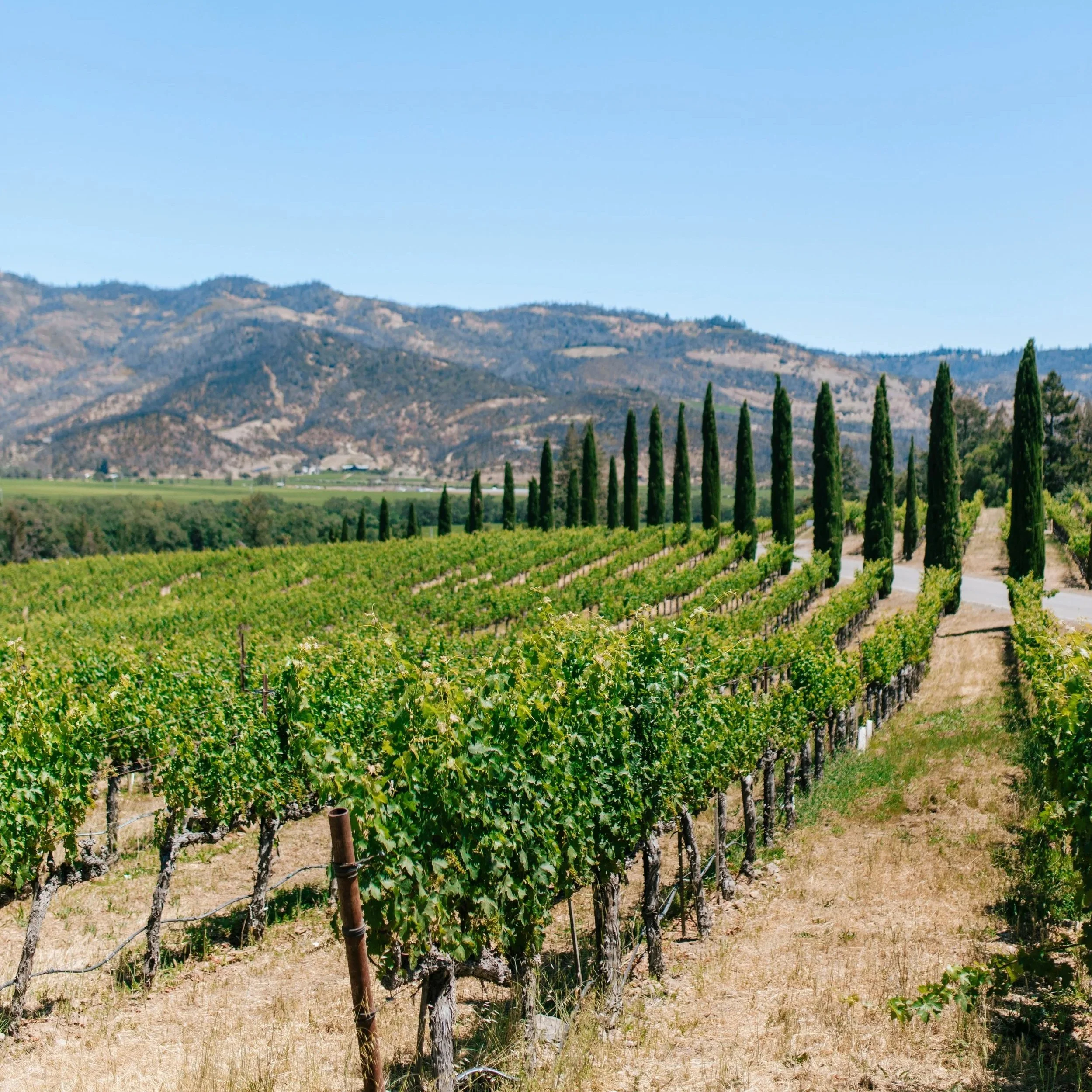
Vineyard in Napa Valley. Photo credit, Lisha Riabinina
Cabernet Sauvignon did not just spring from the ground in Bordeaux, only to be cut and sent to the United States. Through a selective breeding that began in 17th century France (specifically around the Loire Valley and Bordeaux), cabernet franc was successfully combined with sauvignon blanc. Cabernet franc is still grown in both the Loire and Bordeaux today. While usually used as a blending grape for Right Bank red wines, cabernet franc is raised on its own in the Loire Valley. You might know the Loire River as the one that has all of the magnificent châteaux along it. Close to Château Chenonceau (which spans the River Cher like a bridge), wine made of malbec (known as côt in the Loire Valley) and cabernet franc is produced beside some of the finest sauvignon blanc in the world. Down the river, past magnificent castles such as Azay-les-Rideau and Langeais, one finds the imposing, medieval keep of Chinon.
The historic lands of Château de Chinon cultivate some of the finest grapes in France. Chinon is a wine of 100% cabernet franc. It is more tannic (or mouth-drying) than its child with sauvignon blanc to the south, but the fruity characteristics are still there. Chinon can have several different styles: there are more earthy, funky, country styled Chinons as well as elegant, delicate wines with leaner tannins and developed fruit flavors. To the layperson, these are just boilerplate winetalk, so let me give you a couple of examples:
If you’re looking for the barnyard-y kind of flavors that come with rustic cabernet franc, look no further than Bernard Baudry’s Chinon “Les Grezeaux;” having tasted both the 2021 and the 2022, I find them both to be delicious, although a quick decanting allows the 2022 to really come into its own. These wines still have all of the fruit that Napa promises, but the cooler Loire Valley air allows the vintners to produce complex, acidic wines, where the flavors are not drowned out by the fruit and alcohol that come with hot growing seasons. On the other hand Olga Raffault produces excellent elegant Chinons. Olga Raffault Chinon “Les Picasses” is a fantastic bottle whose late 2000s vintages are easily less than a quarter the price of the same vintages from Corison Winery and Ridge Vineyards of the Napa Valley. She also has a baseline wine that makes for a great week-night bottle to have with anything from bolognese to a tomahawk ribeye.
If you’re a fan of those warmer-climate wines with elevated levels of alcohol, though, we have to journey a little further south, to the Côtes du Rhône. There are plenty of generic Côtes du Rhône blends made by great producers (“la Solitude” by Famille Lançon is a great, easy-to-find wine for a quick introduction to the basic flavors of the Southern Rhône). I find that the smaller producers of the Rhône Valley are just as good.
While Bordeaux has been sliced up by global companies and private equity firms— just like Napa— the Rhône remains remarkably family owned. You might find a few grand producers, E. Guigal is a massive operation working both in the Northern Rhône as well as the South, but the majority of wine made in this region is smaller and still family owned. On the upper end of the spectrum of price, you might find some rich, age-worthy Châteauneuf du Papes, and on the lower end, there are always wines from Gigondas (Château St. Cosme might be a large producer, but they’re great introductory-level vintner) and Cairanne, the newest appellation recognized in the Southern Rhône by the French government.
I would hate to monopolize your time with only wine from France, and I willingly make an honorary call-out to all the sangiovese lovers out there. While I’m certain most of my readers know about Chianti (especially with someone’s liver and f-f-f-ava beans), you might not know about the other versions of sangiovese produced in Italy. While a lot of the complexity in French wine law surrounds inheritance or the rules surrounding how wine must be made, in Italy, these laws are just as stringent, but they are joined by the fact that the entire country cannot agree on what these grapes should be called from region to region, or even from producer to producer.
The most famous name for this grape, sangiovese (which translates to mean “Blood of Jupiter,) but this is one of more than fifty different synonyms. Other famous names for sangiovese are brunello, rosso di Montalcino, calabrese, chiantino, and montepulciano. While there are stylistic differences between regions, producers, and winemaking practices, these grapes hold many of the same characteristics. They will be cherry forward, holding a wonderful fruitiness while still being tannic enough to stand up to all kinds of red meats, tomato dishes, and hearty stews.
A few of my favorite producers that aren’t Chianti include Duca di Cardino (of Montapulciano), Siro Pacenti (of Montalcino), and Voliero (of Montalcino). All of these are sourceable throughout the United States, and promise to be affordable, yet still luxurious.
Duca di Cardino promises dark fruits, leather, and chocolate— similar flavors to a well-aged cabernet sauvignon, without the overt fruitiness that can overwhelm secondary flavors. Siro Pacenti is famous for its founder’s intense dedication to his vines. While their holdings might have grown, when Pacenti started out, he would sponge off each leaf in his small vineyard. They still haven’t lost that individualistic care for each and every one of their vineyard sites around Montalcino. Finally, on the more expensive end (especially in restaurants), Voliero’s Brunello di Montalcino is one of the finest examples of Brunello on the market today. It might not be Biondi-Santi or Poggio di Sotto, but its quality is obvious. I suggest a longer decant with younger years of these three wines, especially for those drinkers who are looking to test their palettes and expand their tasting skills.
The Napa Valley winemakers have an uphill battle with the changing demographics of the market, the increased cost of doing business, and of course, the dread specter of climate change. Luckily, for the rest of us, there are plenty of careful producers, whose views and philosophies on vineyard management and wine-growing are proving to be exactly what the industry needs. It’s up to us to seek them out, to discover new vintners for ourselves, and most importantly, to share them with our friends and family.
Together, let’s find the pairings of each of our lives.